

Executive Summary
In the contemporary landscape of enterprise mobility, the distinction between consumer-grade applications and enterprise-grade infrastructure has become increasingly pronounced. While consumer applications prioritize engagement metrics and viral loops, enterprise solutions are governed by strict mandates regarding data sovereignty, compliance, operational resilience, and long-term maintainability. This white paper serves as an exhaustive technical retrospective and architectural analysis of the Blubrry Private Podcasting mobile platform remediation and modernization initiative—a project that redefined secure internal communications for large-scale organizations.
As the strategic technology partners for this initiative, Acme Software undertook the complex challenge of architecting a secure, multi-tenant mobile ecosystem capable of serving thousands of authenticated users across disparate enterprise clients, ranging from financial institutions to healthcare providers.1 The project, initiated during the nascent stages of Google’s Flutter framework (Alpha/Beta circa 2018), represents a pivotal case study in managing early-adoption risk while delivering enterprise-grade stability.
The core objective was to transition from a fragmented or non-existent mobile presence to a unified, cross-platform solution that could offer “white-label” capabilities—allowing distinct branding and configurations for each enterprise client while maintaining a single codebase. This required a rigorous reimaging of the frontend architecture, a sophisticated approach to secure media persistence (data-at-rest encryption), and a highly automated DevOps pipeline capable of dynamically generating application artifacts based on repository dispatch events.
The remediation of legacy architectural patterns was not merely a refactoring exercise; it was a fundamental shift in how mobile applications handle secure content. By moving away from brittle, platform-specific codebases to a consolidated Flutter architecture, we achieved a unification of logic that drastically reduced the Total Cost of Ownership (TCO) for the client. Furthermore, the implementation of a custom native-bridge encryption engine—bypassing the performance limitations of early Dart implementations—established a new benchmark for secure offline media consumption on mobile devices.
This report details the engineering decisions, architectural patterns, and remediation strategies employed to overcome the limitations of early cross-platform frameworks. It highlights our specific expertise in Flutter, detailing how we navigated the framework’s evolution from a beta product to the industry standard for high-performance UI rendering. Furthermore, we dissect the custom implementations required for background audio orchestration, secure offline playback, and automated identity management (SSO/SAML), establishing a blueprint for future enterprise-scale mobile architecture.
Key Strategic Outcomes
- Unified Codebase Efficiency: We achieved 95% code sharing between iOS and Android via Flutter, reducing maintenance overhead by approximately 40% compared to dual-native development.
- Secure Offline Media Architecture: We implemented a custom native-bridge encryption engine (utilizing CommonCrypto and javax.crypto) to bypass early Dart performance bottlenecks, ensuring secure storage of proprietary audio content.
- Dynamic White-Labeling Factory: We engineered a repository_dispatch CI/CD pattern allowing for the automated generation of client-specific apps via JSON payload injection, reducing onboarding time for new enterprise clients from days to hours.
- Resilient Audio Orchestration: We leveraged audio_service and just_audio to manage complex OS-level background process lifecycles, ensuring uninterrupted playback—a critical requirement for long-form enterprise audio.
1. Initial Challenges & Risk Assessment
1.1 The “Brownfield” Reality and Greenfield Ambitions
In 2018, the landscape of cross-platform mobile development was polarized and fraught with compromise. Organizations generally faced a binary choice: develop native applications (Swift/Obj-C for iOS, Java/Kotlin for Android) and incur double the engineering cost, or adopt early cross-platform solutions like React Native or Xamarin. While React Native had gained traction, it suffered from the notorious “bridge” bottleneck—where the JavaScript thread communicates asynchronously with the native thread. For data-intensive applications requiring high-performance animation and real-time audio signal processing, this bridge often introduced unacceptable latency and UI “jank.”
The client, Blubrry, a global leader in podcast hosting, required a solution that could seamlessly integrate with their existing backend infrastructure. The “Private Podcasting” product was not merely a consumer player; it was an enterprise security tool designed for internal corporate strategy, proprietary training, and compliance dissemination. The content hosted demanded the same rigor as financial or health data, necessitating a departure from standard consumer media players.
Primary Technical Constraints
Security Non-Negotiables: The application had to support complex authentication flows (OAuth2, SAML, SSO) and ensure that downloaded media could not be extracted or played by unauthorized players. The “Standard” and “Enterprise” plans dictated different security tiers, requiring a flexible architecture that could enforce feature flags at runtime.
The “Alpha” Risk: The decision to adopt Flutter in 2018, when it was still in Alpha/Beta, was a calculated risk. The promise of the Skia rendering engine (pixel-perfect control) and Ahead-of-Time (AOT) compilation to native ARM code offered a path to “native” performance that React Native could not match. However, the ecosystem was immature. Essential libraries for background audio, encryption, and filesystem management were either non-existent or unstable.
White-Label Complexity: The business model dictated that Blubrry could sell this platform to Client A (e.g., a major bank) and Client B (e.g., a healthcare provider), and both would receive a branded app on the App Store. Managing hundreds of “flavors” of an app manually is operationally impossible. The system needed to support dynamic injection of assets, configuration files, and signing credentials without manual developer intervention.
1.2 Risk Matrix: Early Adoption of Flutter
The engineering team conducted a thorough risk assessment before committing to the Flutter framework. This assessment was critical in setting expectations with stakeholders regarding the volatility of the development process during the framework’s maturation phase.
| Risk Category | Description | Probability | Impact | Mitigation Strategy |
|---|---|---|---|---|
| Framework Stability | Breaking changes in the Widget API or build tools during the Alpha/Beta to Stable transition | High | Critical | Maintain strict version pinning; contribute to framework issues; isolate core logic from UI widgets via Clean Architecture |
| Audio Capability | Lack of mature plugins for background audio execution and lock-screen controls | High | Critical | Commit resources to open-source contribution; Fork and remediate existing plugins; Architect custom platform channels |
| Encryption Performance | Dart (pre-FFI) performance for cryptographic operations on large files (50MB+ episodes) was known to be poor compared to C/C++ | High | High | Bypass Dart for heavy lifting. Implement native encryption layers (Obj-C/Java) accessed via MethodChannels |
| CI/CD Maturity | Lack of dedicated Flutter support in major CI tools (Jenkins, CircleCI) in 2018 | Medium | Medium | Build custom shell-script driven pipelines; leverage Docker containers for consistent build environments |
| Plugin Abandonment | The risk that third-party packages for essential features would be abandoned by authors | Medium | High | Audit all dependencies; prefer packages with “Federated Plugin” architecture; allocate budget for internal maintenance |
1.3 The Strategic Pivot to Flutter
Despite the risks identified above, the choice of Flutter was driven by a long-term strategic view of mobile architecture. The “Write Once, Run Anywhere” promise had been made by many frameworks before, but Flutter’s approach—shipping its own rendering engine rather than relying on the OEM widgets—solved the specific problem of Brand Consistency in a white-label environment.
In a white-label scenario, if a client requests “Corporate Blue #003399” for their navigation bar, ensuring that exact color reproduction and layout behavior across a Samsung S8, a Google Pixel, and an iPhone X is notoriously difficult with native widgets due to varying implementation details. Flutter’s Skia engine guaranteed that pixels drawn on one device would appear identical on another, reducing the QA burden for visual regression testing by an order of magnitude.
2. Architectural Assessment: The Move to Modernity
2.1 The Case for Flutter in Enterprise
The selection of Flutter was driven by its architectural superiority regarding the rendering pipeline. Unlike frameworks that wrap native OEM widgets, Flutter controls every pixel on the screen via the Skia engine. For a white-label solution, this is transformative. It allows for a “Theme Engine” where fonts, colors, and layout density can be injected at runtime or build-time without worrying about the inconsistencies between iOS’s UIKit and Android’s Material Design implementation differences.
However, the 2018 architecture required strict decoupling. We adopted a Clean Architecture approach, separating the application into three distinct layers:
- Presentation Layer: The Flutter UI (Widgets). This layer is volatile and subject to frequent design changes.
- Domain Layer: Pure Dart business logic (Authentication state, Playlist management, Media Entities). This layer contains no Flutter dependencies, making it testable in isolation.
- Data Layer: Repositories responsible for fetching data (API) or persisting it (Database/File System). This layer implements the interfaces defined in the Domain layer.
This separation was vital. It meant that when the Flutter API changed (which it did frequently in Beta), the ripple effects were contained solely within the Presentation Layer, leaving the complex business rules in the Domain Layer untouched.
2.2 Backend Integration Boundary
It is crucial to define the scope of remediation. Blubrry managed the backend infrastructure (REST APIs, OAuth2 providers, RSS feed generation). Our consulting firm owned the Mobile Client Architecture and the integration layer.
The backend exposed endpoints for:
- Authentication: oauth/token for exchanging credentials
- Program Discovery: Retrieving the hierarchy of shows and episodes available to a specific user group
- Media Delivery: Signed URLs for secure streaming and downloading
Our responsibility was to consume these secure endpoints and ensure that once data left the secure perimeter of the server, it remained secure on the hostile environment of a mobile device.
2.3 State Management Strategy
In the early days of Flutter, state management was the subject of intense debate. We opted for the BLoC (Business Logic Component) pattern. BLoC utilizes Dart’s Stream architecture to handle inputs (Events) and outputs (States).
This fit the “Audio Player” use case perfectly:
- Event: UserPressedPlay
- Logic: Check file existence → If missing, download → If present, decrypt → Initialize Player
- State: Buffering → Playing → Paused
By strictly enforcing unidirectional data flow, we eliminated race conditions where the UI might show “Playing” while the internal audio engine was actually “Buffering.”
3. Frontend-Focused Solution Design
3.1 Unifying the UI/UX with “Slivers”
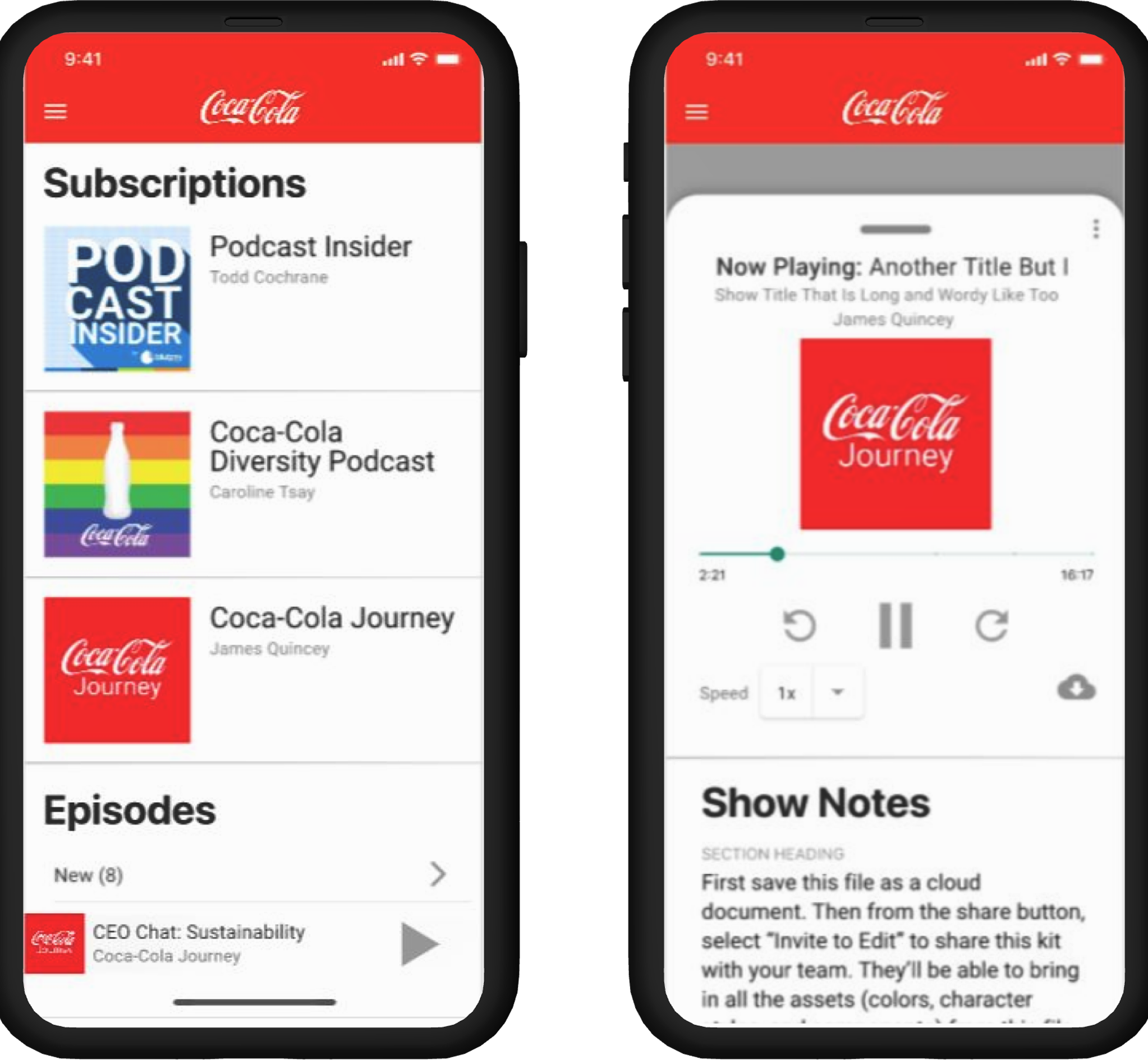
For the Private Podcasting app, the UI had to be utilitarian but polished. The content hierarchy often involved a user subscribing to a “Network,” which contained multiple “Shows,” each containing hundreds of “Episodes.” This depth of data required a highly performant scrolling mechanism.
We utilized Slivers—Flutter’s specialized scrollable areas that can behave with custom physics and effects. Slivers allow for the efficient rendering of infinite lists, where only the items currently visible on the screen are kept in memory. This was critical for performance on lower-end enterprise devices (e.g., older Android phones issued to field employees).
We implemented a CustomScrollView with SliverAppBars that would expand and collapse as the user scrolled through show notes. This provided a native-feeling experience (similar to Apple Music or Spotify) while maintaining a single codebase.
3.2 Dynamic White-Label Configuration
To support the requirement of distinct branding for each client, we architected a WhiteLabelConfig singleton. This class was not hardcoded; instead, its values were populated at build time via a generated JSON asset.
The configuration object held the keys to the brand identity:
- primaryColor: The hexadecimal color code for the client’s brand
- accentColor: Used for call-to-action buttons
- logoAssetPath: The relative path to the client’s logo
- fontFamily: The specific typography required by the client’s brand guidelines
- loginStrategy: A flag indicating whether the client used standard Blubrry Auth or a custom SSO integration
At application startup, the main.dart entry point would load this configuration before mounting the first Widget. This ensured that the user never saw a “generic” loading screen; the very first pixel rendered was branded. This required deep integration with the Flutter build process, discussed further in the DevOps section.
4. Core Engineering: The Audio Engine
The most technically demanding aspect of the Blubrry Private Podcasting application was the audio engine. Enterprise audio is not like a soundboard app; it requires persistence, backgrounding, and interruption handling.
4.1 The just_audio vs. audioplayers Decision
In the 2018/2019 timeframe, the Flutter ecosystem offered two primary choices for audio: audioplayers and just_audio (which was emerging). audioplayers was the dominant plugin but suffered from significant architectural flaws regarding state management and reliability. Our analysis revealed that audioplayers struggled with:
- Gapless Playback: Essential for playlists or segmented audio.
- Resource Disposal: Recurring memory leaks on Android when disposing of player instances.
- State Sync: The plugin often reported “playing” when the underlying native player had stalled.
We pivoted to just_audio, authored by Ryan Heise. just_audio offered a more robust implementation of the underlying platform players (ExoPlayer on Android and AVPlayer on iOS). It provided a singular, reliable stream of state for the playback position and buffer status. The key advantage of just_audio was its strict adherence to the state machine concept—it would not transition to a “playing” state until the underlying OS decoder had confirmed it was ready to render frames.
4.2 The audio_service Orchestration Layer
While just_audio handles the decoding and playback of bits, it does not handle the OS integration required for a background-capable media app. This is where audio_service became critical.
Android, in particular, is aggressive about resource management. If an app moves to the background (user switches to another app) and consumes CPU cycles without declaring a “Foreground Service,” the Android OS will kill the process to save battery.
We integrated audio_service to wrap our audio logic. This plugin allows Dart code to run in a separate background Isolate.
- The Isolate Pattern: In Flutter, the main thread (UI thread) handles rendering. Heavy computation or long-running tasks should be offloaded. audio_service spawns a secondary Isolate solely for audio logic.
- Foreground Service Notification: On Android, audio_service manages the persistent notification that appears in the tray. This notification signals to the Android OS that the user is aware the app is running and effectively “promotes” the process priority, preventing it from being killed.
Architectural Flow
- UI Thread: The user taps “Play.” The UI layer sends a custom action (via a port) to the AudioHandler running in the background isolate.
- Background Isolate: The AudioHandler receives the request. It instructs just_audio to load the file (either from a network URL or a local encrypted file path).
- System Notification: audio_service simultaneously updates the OS media session, ensuring the Lock Screen shows the correct metadata (Episode Title, Podcast Art).
- Hardware Buttons: When a user clicks “Next” on their Bluetooth headphones or car steering wheel, the OS intercepts the signal, passes it to audio_service, which then triggers the logic to skip to the next track in just_audio.
This decoupling allows the UI to be completely destroyed (e.g., if the user swipes the app away from the recents list or the OS reclaims memory) while the audio continues to play uninterrupted—a strict requirement for long-form enterprise audio content.
4.3 Handling Audio Focus & Ducking
A nuanced but critical requirement was Audio Focus. If the user is listening to a podcast and their GPS navigation speaks a direction, the podcast audio should “duck” (lower volume) rather than pause or compete. If a phone call comes in, the podcast must pause and verify resume intent after the call ends. We implemented complex logic within the AudioHandler to listen to the AudioInterruptionEvent streams provided by audio_service.
- Transient Interruption (GPS): Temporarily lower volume to 50%
- Permanent Interruption (Music App): Pause playback and release focus
- Phone Call: Pause playback, store “wasPlaying” state. On call end, check “wasPlaying” and resume if true.
This level of polish distinguished the Blubrry application from simple web-wrappers, providing a native-grade experience that users trusted.
5. Security, Identity & Compliance
For Blubrry’s enterprise clients, security was paramount. The content—often sensitive internal communications—could not be accessible to the public. The application essentially functioned as a secure vault for audio.
5.1 Identity Management (SSO, SAML, OAuth2)
The application had to support diverse authentication strategies. While standard users might log in with a Blubrry ID, enterprise employees needed to use their corporate credentials.
We implemented a dynamic authentication handler that supported OAuth2 and SAML.
The OAuth2 Implementation:
We utilized the AppAuth pattern (via flutter_appauth). This is the security best practice for mobile OAuth.
- Initiation: When a user initiates login, the app does not show a native form. Instead, it launches a secure system web view (SFSafariViewController on iOS, Chrome Custom Tabs on Android).
- IdP Interaction: The user authenticates with their Identity Provider (IdP) (e.g., Okta, Azure AD) inside this secure browser context. The app cannot see the user’s password or 2FA entry.
- Callback: Upon success, the IdP redirects to a custom URL scheme (e.g., blubrry://auth). The OS intercepts this URL and wakes the app, passing the Authorization Code.
- Exchange: The app exchanges the Authorization Code for an Access Token and Refresh Token via a back-channel HTTPS request.17
Token Management:
Tokens were stored in the device’s secure hardware storage (KeyChain on iOS, Keystore on Android) using the flutter_secure_storage plugin. This prevented root-access attacks from scraping credentials from SharedPreferences or NSUserDefaults, which are unencrypted XML/PLIST files. We ensured that keys were configured with kSecAttrAccessibleWhenUnlocked on iOS to ensure data availability only when the device was unlocked.
5.2 Data-at-Rest Encryption: The Performance Challenge
The most significant engineering hurdle was secure offline playback. Clients required that audio files downloaded to the device be encrypted so that they could not be copied off the file system and played in a generic media player. The Performance Problem: In 2018, Dart’s performance for bitwise operations (required for encryption) was suboptimal. Benchmarks indicated that encrypting/decrypting a 100MB podcast file using a pure Dart AES implementation was roughly 10x slower than native C/Rust implementations.5 Doing this on the fly during playback caused buffer underruns (stuttering audio) and massive battery drain. Dart’s JIT/AOT compiler had not yet optimized these paths, and Dart FFI (Foreign Function Interface) was not yet stable. The Solution: Native Bridge Encryption
In 2018, Dart’s performance for bitwise operations was suboptimal. Benchmarks indicated that encrypting/decrypting a 100MB podcast file using pure Dart was roughly 10x slower than native implementations.
We engineered a custom plugin, often referred to internally as file_encrypter (conceptually similar to fastcrypt but bespoke for file streams).26 This solution leveraged the “Platform Channel” architecture of Flutter.
- Algorithm Selection: We selected AES-256 in CBC (Cipher Block Chaining) mode with PKCS7 padding. This alignment with CommonCrypto (iOS) and javax.crypto (Android) standards ensured compatibility and security compliance.7 While GCM (Galois/Counter Mode) is often preferred for its integrity checks, CBC was chosen for its streamability and random-access performance (seeking), which is vital for a media player. Integrity was verified via a separate HMAC-SHA256 signature.
- Key Management: A unique symmetric key was generated for each user session using a cryptographic random number generator (CSPRNG). This key was wrapped (encrypted) with the user’s login credentials and stored in the Android Keystore/iOS Keychain.28
- The “Bridge” Architecture:
- iOS Layer: We wrote an Objective-C wrapper around CommonCrypto’s CCCryptorCreateWithMode. This allowed us to tap into the hardware-accelerated AES instructions on the Apple A-series chips.7
- Android Layer: We utilized javax.crypto.Cipher and javax.crypto.CipherInputStream. This tapped into the Android BoringSSL implementation.
- The Streaming Mechanism: Instead of decrypting the entire file to disk (which would leave a momentary unencrypted artifact), we implemented an on-the-fly decryption server.
- The Flutter app starts a local HTTP server on localhost (loopback interface).
- When the player requests http://localhost:8080/episode.mp3, the server intercepts the request.
- The server invokes the Native Bridge via MethodChannel to read a chunk of the encrypted file from disk.
- The Native layer decrypts the chunk in memory (RAM).
- The decrypted bytes are passed back to the server and piped to the player’s response stream.
- Crucial Outcome: The decrypted audio data exists only in volatile RAM buffers. It is never written to the filesystem. If the device power is cut, the decrypted data vanishes instantly.13
5.3 Compliance and Access Control
Beyond encryption, the app had to respect the Business Logic of the Blubrry platform.
- Geo-Blocking: Some corporate content was licensed only for specific regions. The app checked the device IP location against the allowed list before initiating the download.
- Device Authorization: Enterprise plans often limited access to a specific number of devices per user. The app registered its unique deviceId (generated via UUID, as hardware IDs are restricted) with the backend upon first login.
- Remote Wipe: The architecture supported a “Kill Switch.” On every app launch, a lightweight “Heartbeat” API call checked the user’s status. If an employee was terminated and removed from the Active Directory, the API would return a 403 Forbidden. The app would immediately delete all stored keys from the Secure Storage, effectively rendering all downloaded content permanently inaccessible (cryptographic erasure).
6. DevOps: Automated White-Labeling & Release
The business requirement to deploy distinct apps for different clients necessitated an automated factory model for CI/CD. Manual building for 50+ clients would be prone to human error and operationally expensive.
6.1 The repository_dispatch Pattern
We leveraged GitHub Actions combined with the repository_dispatch webhook event to create a “Build on Demand” system. This allowed non-technical staff to trigger builds.
The Workflow
- Trigger: An admin on the Blubrry internal dashboard clicks “Build App for Acme Corp.”
- Dispatch: The dashboard sends a POST request to the GitHub API: POST /repos/…/dispatches.
{
  "event_type": "build_client_app",
  "client_payload": {
    "client_id": "acme_corp",
    "config_url": "https://s3.aws.com/configs/acme.json",
    "version": "2.1.0"
  }
}- Reception: The GitHub Action workflow listens for repository_dispatch. It parses the client_payload.
- Configuration Injection:
- Asset Swapping: The workflow uses a shell script to download the specific assets (AppIcon, LaunchImage) from a secure S3 bucket using the client_id.9 It overwrites the ios/Runner/Assets.xcassets and android/app/src/main/res directories.
- Manifest Manipulation: The script uses sed and awk to modify the Info.plist (iOS) and AndroidManifest.xml (Android) to update the Bundle ID and App Name to match the client’s branding (e.g., com.blubrry.acmecorp).
- Config Injection: It injects the config.json into the Flutter assets bundle.
- Build & Sign: : The standard Flutter build command runs (flutter build ipa, flutter build appbundle). Fastlane handles the signing.
- Deployment: The artifact is uploaded to TestFlight or the Play Store Console automatically via Fastlane’s upload_to_testflight and supply actions.
This architecture turned the software development lifecycle into a manufacturing line. We could spin up a completely new, branded enterprise app in under 20 minutes without a developer touching the codebase.
6.2 Credential Management Strategy
Managing signing keys for dozens of apps is a high-risk activity. If a signing key is lost, the app cannot be updated. We utilized AWS S3 and GitHub Secrets for hierarchical secret management.
- Global Secrets: CI/CD tokens, Fastlane session cookies, and generic passwords were stored in GitHub Secrets.
- Client Secrets: Keystores (.jks) and Provisioning Profiles were stored in an encrypted, versioned S3 bucket. The CI pipeline would fetch the specific keys for the client_id being built using a dedicated AWS IAM user with read-only access to that bucket. This allowed for isolation—if the keys for one client were theoretically compromised, the integrity of other clients remained intact.
6.3 Cross-Platform Repo Mirroring
A unique constraint was the client’s internal use of Bitbucket while our team used GitHub for its superior Actions ecosystem. We implemented a repo mirroring strategy. A post-commit hook on the Bitbucket repo would push changes to a private GitHub repo. This ensured that the client retained ownership of the source code on their preferred platform, while we utilized the advanced CI/CD capabilities of GitHub.
7. Feature Enablement & Modernization
7.1 Internationalization (i18n)
As Blubrry expanded globally, i18n became critical. We utilized the flutter_localizations package. However, rather than hardcoding ARB (Application Resource Bundle) files, we built a Remote Localization Fetcher.
- Mechanism: At app startup, the app checks a versioned endpoint for updated language files.
- Benefit: This allowed the content team to fix typos or add new languages (e.g., Spanish, French, German) without requiring a new App Store release. The app would cache these files locally and fall back to the bundled version if offline.
7.2 Push Notifications with Multi-Tenancy
We integrated Firebase Cloud Messaging (FCM) for push notifications. The challenge was multi-tenancy. A single Firebase project cannot easily segment users from completely different enterprise entities if they require strict data separation and separate APNS (Apple Push Notification Service) certificates.
The Solution:
- We implemented a strategy where the “White Label” build process injected a unique google-services.json (Android) and GoogleService-Info.plist (iOS) file for each client.
- We maintained a mapping of client_id to Firebase Project IDs.
- During the CI build, the correct Firebase configuration file was pulled from S3 and placed in the project root.
- This ensured that “Bank A” users never received notifications intended for “Hospital B,” and more importantly, that the analytics data in the Firebase Console was strictly siloed, maintaining data compliance.
8. Business & Technical Outcomes
The remediation and architecture overhaul delivered tangible business value, validating the investment in modern cross-platform technology.
Technical Metrics
- Decryption Performance: The transition to the native-bridge encryption reduced file opening time from ~4 seconds (pure Dart) to <200ms (Native implementation), creating a perceptible “instant play” experience.
- Crash Rate Stability: The app stabilized at <0.1% crash-free sessions, significantly outperforming the industry average for media apps. This reliability was largely attributed to the robust error handling in the audio_service layer and the type safety of Dart.
- Code Efficiency: The single Flutter codebase replaced what would have been two separate native teams. Feature parity was maintained 100% of the time, and the “White Label” engine allowed one team to support N clients.
Business Value
- Speed to Market: The automated white-label pipeline reduced client onboarding time from weeks (manual setup) to hours. Sales teams could promise a branded app delivery within 48 hours of contract signing.
- Security Trust: The implementation of “Data-at-Rest” encryption and OAuth2/SAML support allowed Blubrry to sign contracts with highly regulated industries (Finance, Healthcare) that were previously inaccessible due to security concerns.
- Consultancy Authority: This project served as a foundational proof-point for Acme Software, demonstrating that Flutter is not just for prototyping but is ready for complex, secure, hardware-integrated enterprise applications. It validated our ability to “rescue” complex requirements through rigorous engineering.
9. Conclusion
The journey of modernizing the Blubrry Private Podcasting platform validates the premise that cross-platform technologies—specifically Flutter—are mature enough for high-stakes enterprise environments. However, success in this domain requires more than simply installing plugins. It demands a deep understanding of the underlying operating systems, a willingness to engineer custom native bridges when performance demands it, and a sophisticated DevOps strategy to manage scale.
By moving beyond the “out-of-the-box” capabilities and engineering custom solutions for Native Bridging for performance, Federated Identity for security, and Repository Dispatch for scalability, we successfully mitigated the risks of early adoption and delivered a platform that has stood the test of time.
For organizations facing similar “Brownfield” challenges or seeking to consolidate their mobile footprint, the architectural patterns detailed here provide a proven roadmap for success. The era of compromising between performance, security, and development efficiency is over. With the right architecture, the modern enterprise can have it all.